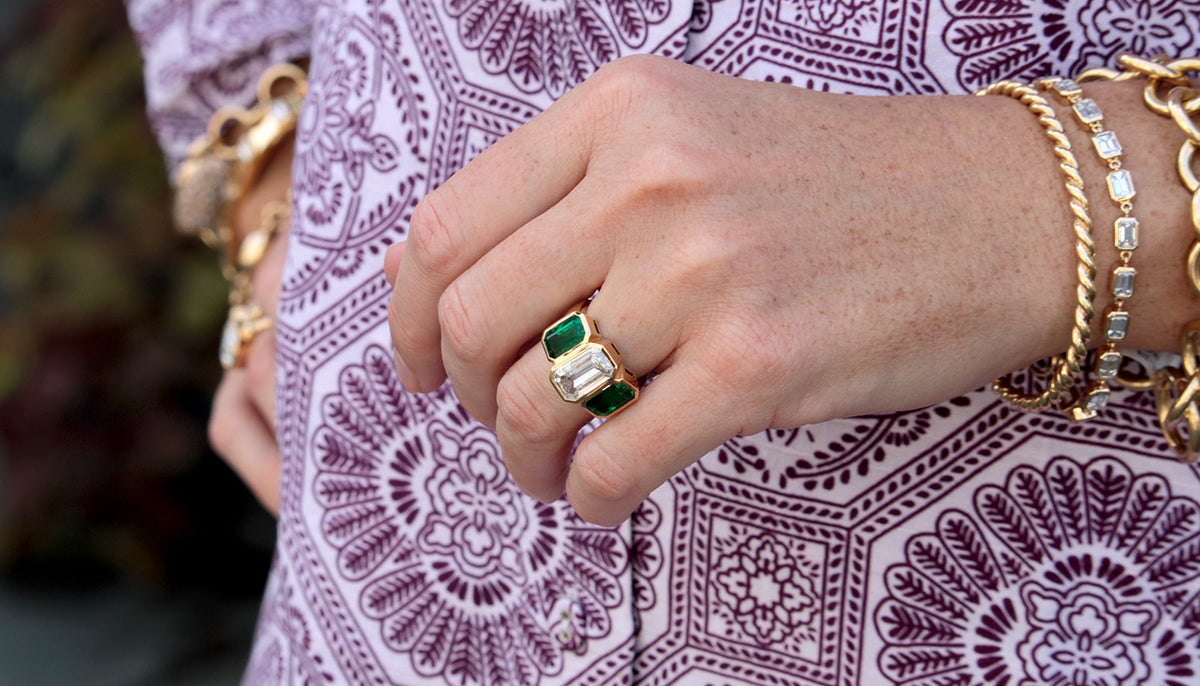


It’s April and that means…DIAMONDS! In honor of this month’s birthstone we will be hosting Ari and Corina of Single Stone for a Trunk Show on Friday, April 12 and Saturday April 13. Ari and Corina, the owners and designers of Single Stone, work together to make the most beautiful jewelry using antique diamonds set in beautiful mountings. Because we LOVE diamonds, especially antique diamonds we wanted to highlight them with some history and facts.


The term “Old Mine” refers to all antique diamonds that were cut by hand. One of our gemologists, Bryan, describes this process for us:

“Antique stones were cut by hand using a wedge cleave and hammer. As you can imagine, no two cuts were identical making all diamonds as unique as snowflakes. This style of cutting diamonds has been used since the end of the 17th century. Unlike today, there were no established standards that had been agreed upon, so a cutter held all the power as to how he would bring out the best that each and every stone had to offer. All of these characteristics give old cut stones a unique look and a different sparkle factor!”


During the Art Deco period, the Old European cut became a new method of cutting that was more precise and defined. A true roundness was achieved with Old European cuts, and these became the predecessor for the modern round brilliant cuts seen today.

“Old European cuts are the most popular cuts of antique diamonds in our store. Although, they may share the same number of facets with their modern brilliant offspring, the shape and placement of each facet gives each cut its uniqueness. Antique stones capture light differently. They draw your eye into the stone. The facets are much larger and are placed to create ‘FIRE’ and they also reflect more light out to the viewer's’ eye in broader angles.”

The father of the modern round brilliant diamond cut, Marcel Tolkowsky, invented a mathematical formula that aimed to achieve the most desirable brilliance in a diamond. In 1919, he published specifications stating that a diamond has to be cut in 58 facets in order to maximize reflected light or its brilliance. This specification later became known as the American Standard and used as a guideline for gemologists and diamond cutters.


